An innovative platform to simplify and secure the use of IoT devices in institutions, offering easy registration and built-in security.
The exponential growth of IoT devices in institutions has brought new challenges in management, security, and usability. Our solution aims to democratize access to IoT technology in a secure and efficient way.
Bureaucratic and technical processes that hinder the adoption of IoT devices
Lack of standardized protocols for IoT devices on institutional networks
Users constantly rely on the technical staff for basic configurations
An intuitive platform that lets users register and manage their IoT devices on their own, with built-in security.
Simplify and secure the use of IoT devices in institutions.
Users register their devices in seconds, without needing the IT team.
Devices connected securely, with user accountability.
Signals prioritized by severity can trigger automatic blocking at the firewall, governed by security policies.
A unified pipeline to monitor, organize, and mitigate.
Consolidates signals from different detection engines to reduce false positives and speed up decision-making.
Standardizes and organizes signals across different detection engines.
Groups signals by context and time to reduce noise and simplify analysis.
Automated triggers for actions (e.g., rules and blocks) when needed.
Records evidence for continuous improvement of the pipeline.
A quick overview of GT IoTEdu: the problem, the proposal, and how the project results connect and culminate in IoTEdu Core.
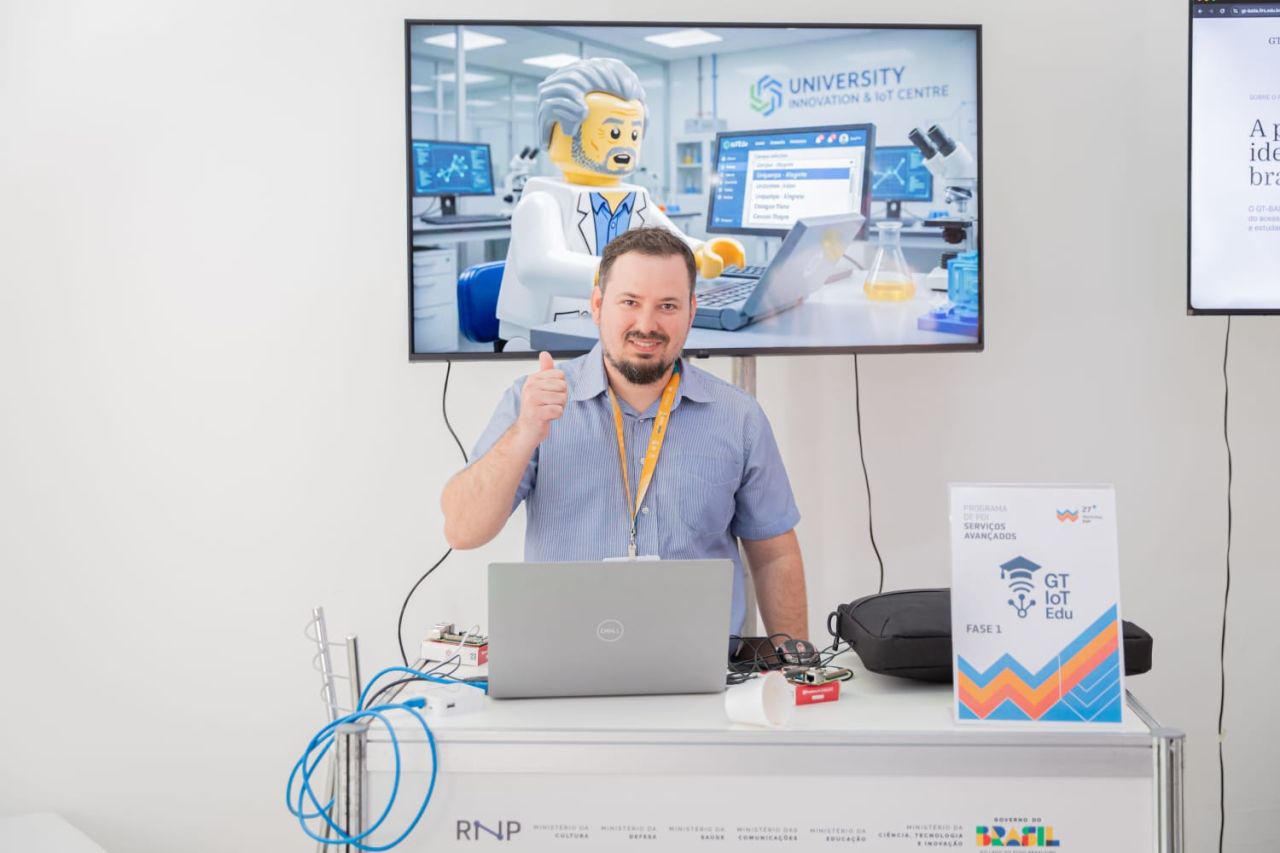
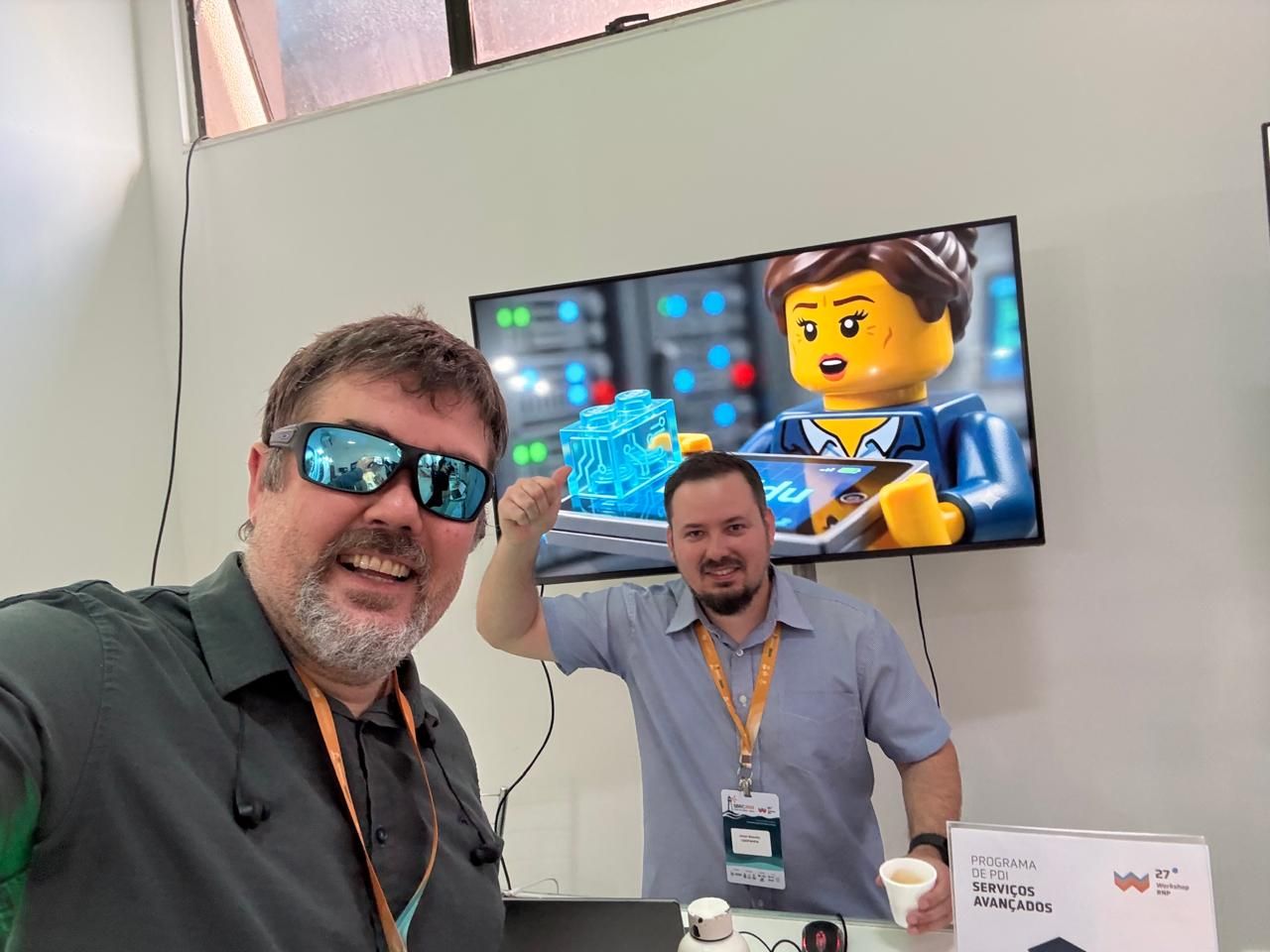
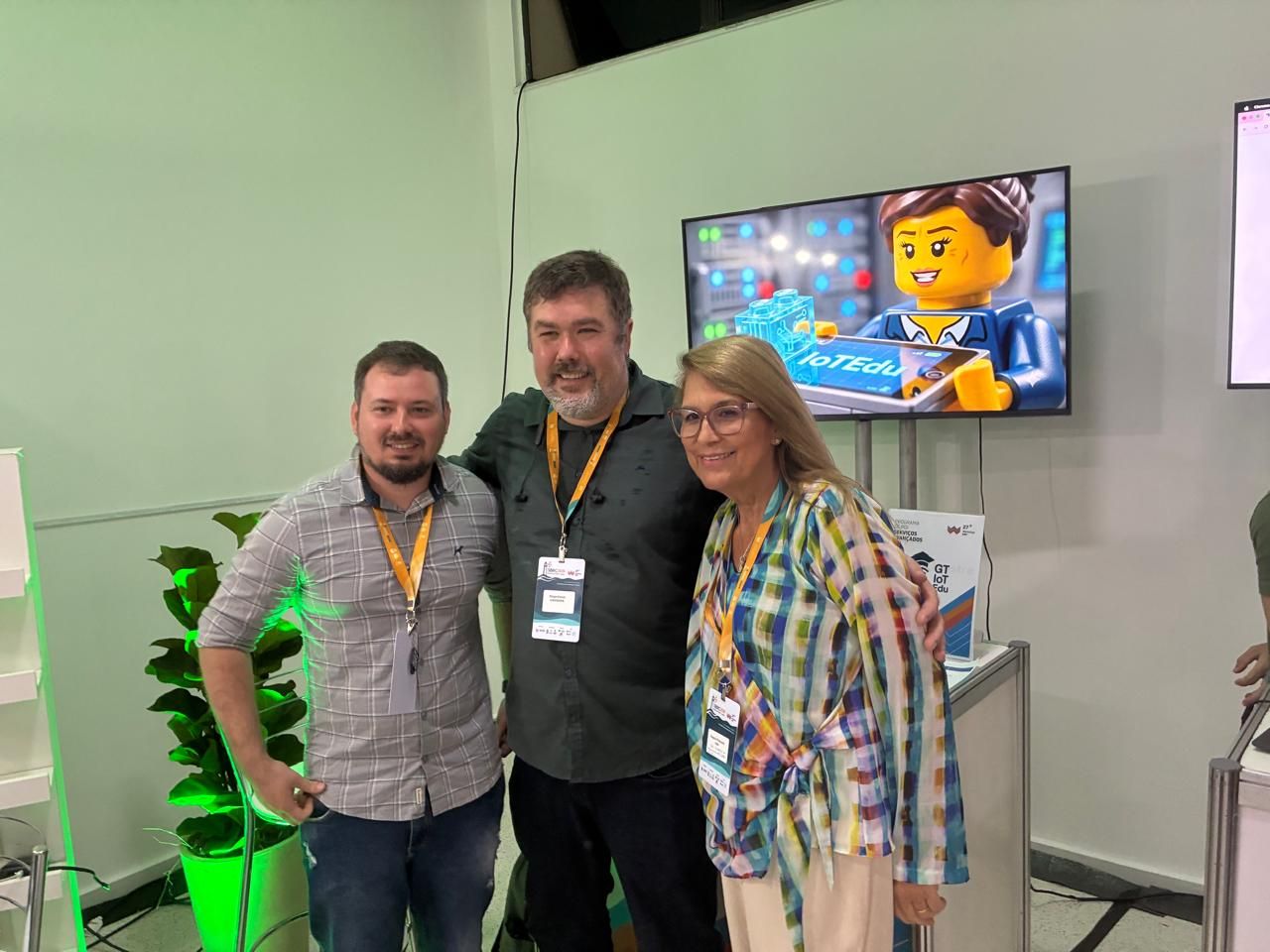
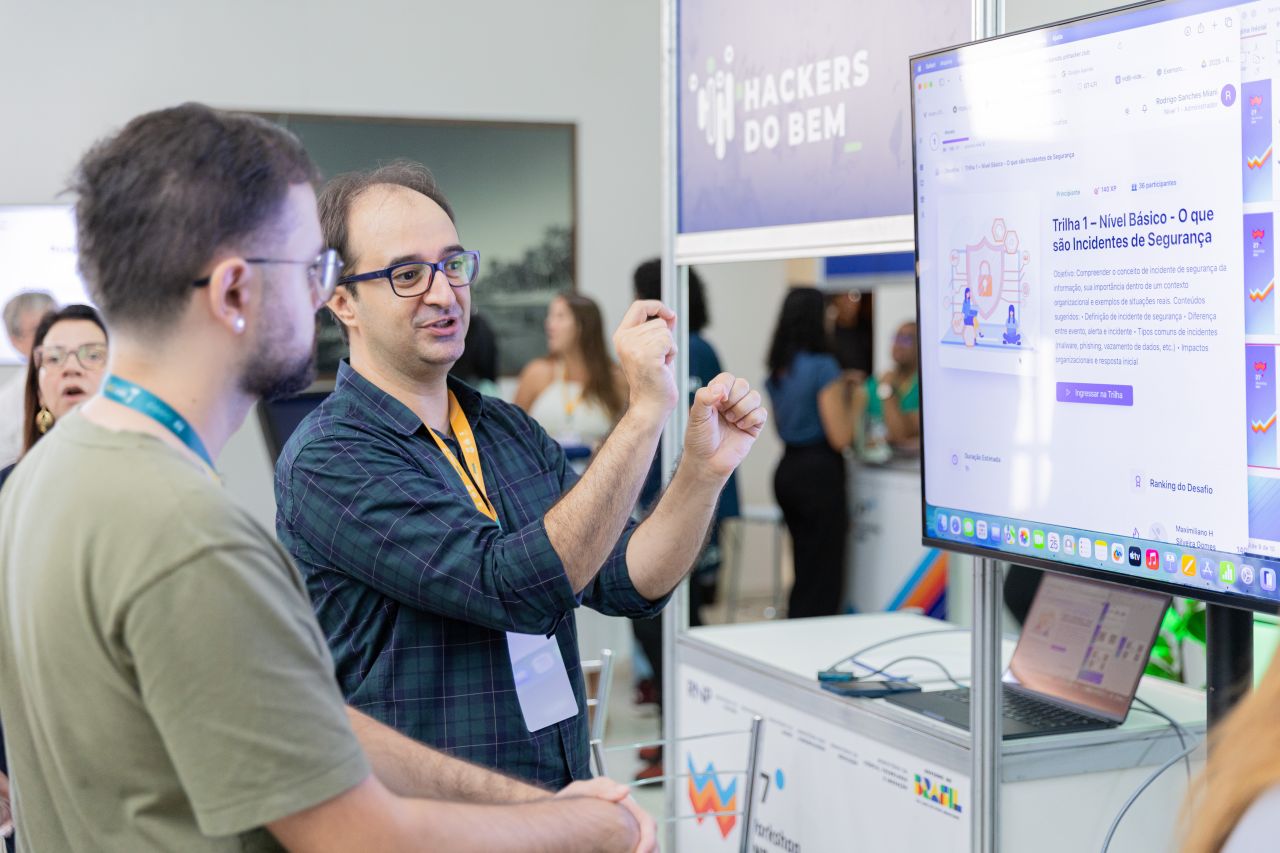
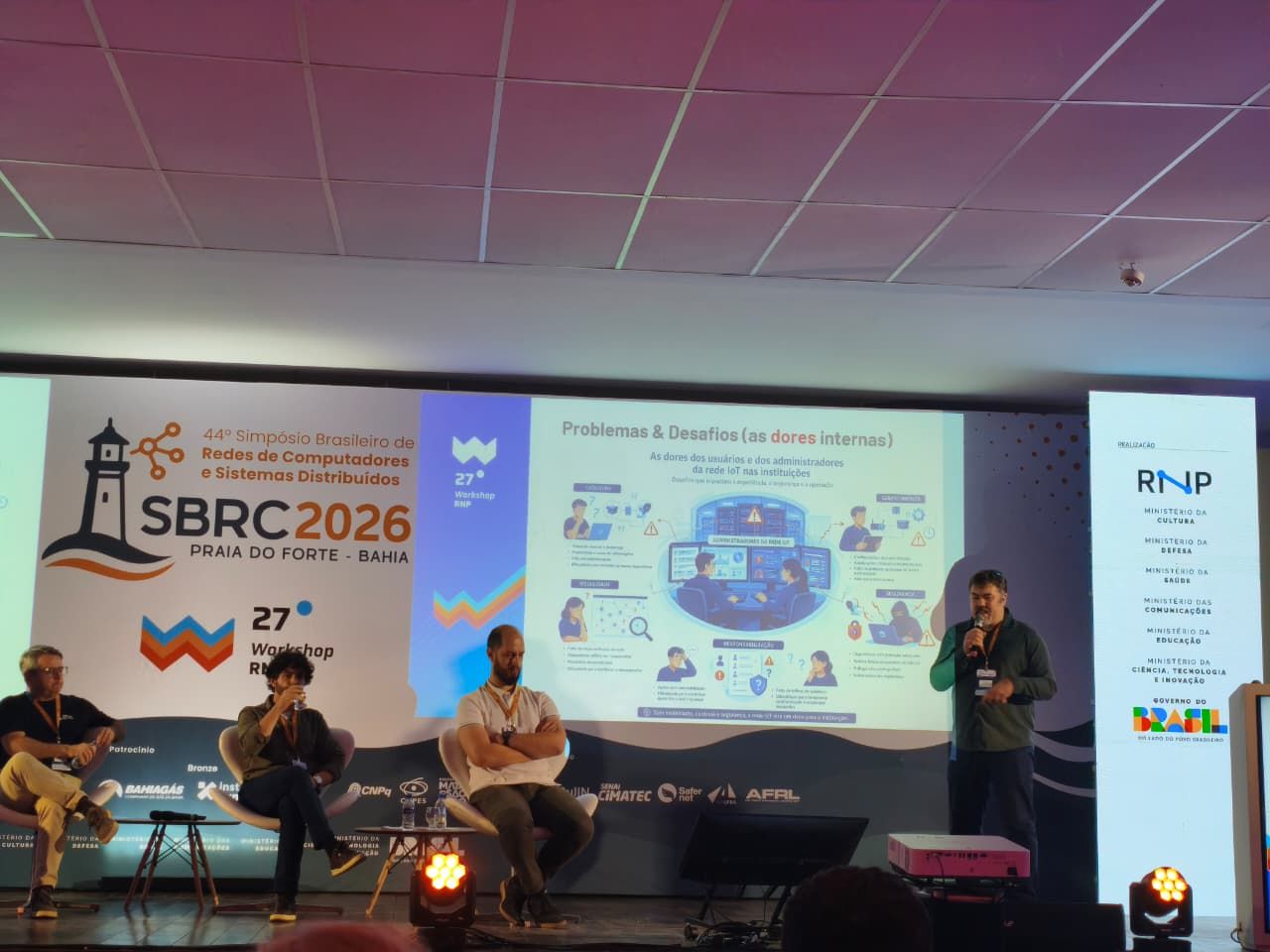
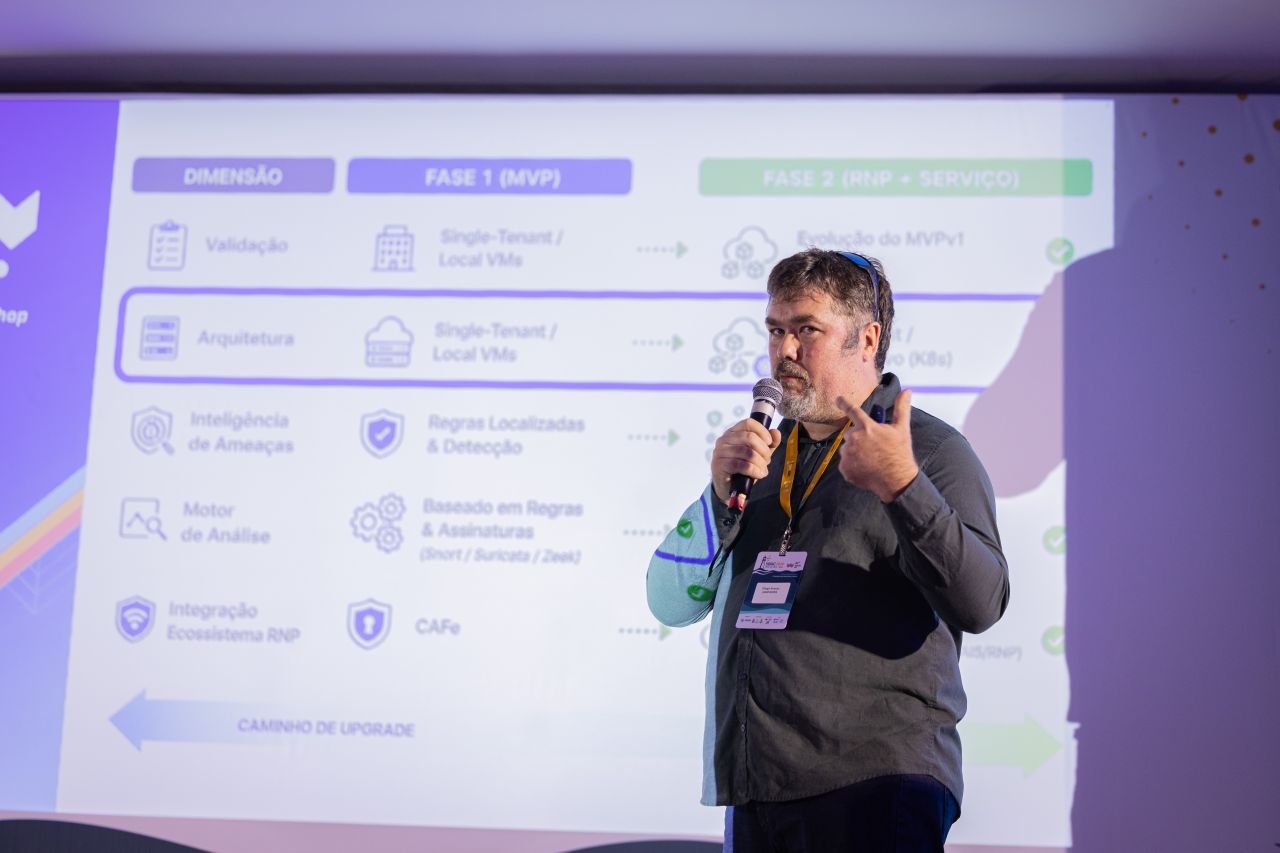
We took the project to Praia do Forte (Bahia, Brazil), represented by Joner De Mello Assolin, Diego Kreutz, and Rodrigo Miani. We gave four presentations: two at WRNP 2026 (booth and main stage) and two at the SBRC 2026 Tools Session (Salão de Ferramentas). The highlights were IoT-ID (deterministic device fingerprinting) and IoT-Zoo (a testbed with more than 40 devices for reproducible, large-scale experiments). We came back with valuable feedback and new collaborations, some of them beyond Brazil!

Explore the products and tools developed throughout the RNP Working Group.
A container-based framework for simulating heterogeneous IoT devices. It automates the deployment of multi-domain scenarios and traffic capture (PCAP) to support research, teaching, and solution validation.
A reproducible environment that integrates a containerized repository of attacks mapped to MITRE ATT&CK. It enables the traceable generation of network traffic datasets for cybersecurity research, teaching, and outreach.
The first stage of the IoT device registration and validation flow: it identifies the device, records metadata, and paves the way for network provisioning and the enforcement of basic security controls.
An evolution of the flow with built-in security: it connects security sensors to the environment and allows firewall policies to be triggered from collected evidence, while maintaining governance and traceability of actions.
A deterministic IoT device identification tool. It uses traffic analysis to produce stable, explainable identities without relying on probabilistic models or AI training.
The core that integrates registration with institutional security. It centralizes the collection of signals and alerts from security sensors and, based on them, enables responses via the firewall.
Labeled network traffic datasets made openly available to the security and IoT research community.
A labeled traffic dataset with 42 attack scenarios in a controlled environment, covering reconnaissance, network exploitation, web attacks, brute force, exfiltration, denial of service, and IoT. Generated by AttackZoo with MITRE ATT&CK mapping.
A packet-level benign traffic dataset captured on the IoT-Zoo testbed, with 43 heterogeneous device profiles across the Urban Observatory, Industrial, e-Health, and Smart Farming domains. It results from the synchronized merging of Scapy and Tshark captures.
A project funded by RNP and developed with the support of leading Brazilian higher education institutions.
Rede Nacional de Ensino e Pesquisa (Brazilian National Research and Educational Network)
A strategic partnership with RNP for the development and deployment of the GT IoTEdu platform, leveraging RNP's national network infrastructure to connect IoT devices securely and efficiently in educational institutions.
A high-speed network connecting institutions
Security protocols for institutional environments
Specialized support for institutions
Meet the researchers and developers behind the project.
Coordination and innovation leadership of the Working Group.
Direct support for the project's innovation activities.
Researchers responsible for the Working Group's technical activities.
Master's and undergraduate students working on the project.
Master's Student - Unipampa
Institutional email
douglasfideles.aluno@unipampa.edu.br
Undergraduate Student - Unipampa
Institutional email
emanuelferreira.aluno@unipampa.edu.br
Undergraduate Student - Unipampa
Institutional email
matheusciocca.aluno@unipampa.edu.br
Master's Student - Unipampa
Institutional email
leonardobitzki.aluno@unipampa.edu.br
Master's Student - Unipampa
Institutional email
rafaeltorres.aluno@unipampa.edu.br
We are looking for institutions interested in adopting IoTEdu and following its evolution closely.
With the platform, users can register their own devices, while the IT team keeps inventory, owner identification, visibility, and security monitoring in a single environment.
By taking part, your institution also provides feedback and helps steer the solution toward real-world needs.